Senior Care at Home: A Guide to Aging with Dignity
A lot of families start in the same place. A daughter notices her father is skipping meals because cooking feels like too much work. A spouse sees that getting in and out of the shower has become unsteady. A son starts fielding more calls about missed medications, unopened mail, or a growing fear of driving after dark. Nothing seems dramatic enough for a facility, but it's clear that living completely alone isn't working the way it used to.
That's where senior care at home often becomes the right next step. Good in-home care doesn't take independence away. It protects it. The right support helps an older adult stay in familiar surroundings, keep preferred routines, and get help where help is specifically needed, instead of uprooting life all at once.
Modern home care also looks different than many families expect. It can include companionship, personal support, specialized neuro care, wellness check-ins, telehealth access, and proactive monitoring that adds another layer of safety. For families exploring options for the first time, that wider view matters. It turns care from a last resort into a practical plan for living well at home.
Embracing Independence with At-Home Senior Care
The first shift for most families is mental. They stop asking, “Is it time for Mom to leave home?” and start asking, “What support would help her stay safely at home?” That question leads to better decisions.

Non-medical in-home care is built around everyday life. It can mean help with meals, reminders, bathing, dressing, errands, transportation, companionship, light housekeeping, or support after a hospital stay when a person is weaker than usual. The aim isn't to medicalize the home. The aim is to make daily living easier and safer.
Many older adults accept help more comfortably when it's framed the right way. They may resist “being taken care of,” but they often welcome someone who helps them keep their routine, get to appointments, stay socially engaged, and avoid exhausting tasks that have started to pile up.
Practical rule: Start care before there's a crisis. Families usually get better outcomes when support begins at the stage of strain, not after a fall, burnout, or emergency room visit.
This kind of care can be light-touch or more involved. Some people need a few hours a week for companionship and transportation. Others need daily help with personal routines. Some need specialized support because a neurological condition has changed mobility, balance, communication, or cognition.
A thoughtful first step is a free consultation. It gives families a way to sort out what's urgent, what can wait, and what level of help fits the home.
Why Aging in Place is the Preferred Choice
Most families don't need convincing that home feels different. They need permission to trust that this preference is reasonable, practical, and often safer than trying to force an older adult into a setting they never wanted.
The data supports that instinct. 90% of seniors prefer aging in place at home, and the average annual cost of home care services is $54,912, which is significantly lower than institutional options according to U.S. home care industry statistics. That preference isn't sentimental alone. It reflects comfort, continuity, and control.
Familiar surroundings reduce friction
At home, people know where everything is. They sleep in their own bed, follow their own morning rhythm, and stay connected to neighbors, pets, favorite chairs, and ordinary habits that still matter. Those details aren't small. They often shape whether a person feels settled or disoriented.
Even simple routines can preserve dignity:
Morning choice: Deciding when to wake up, what to wear, and where to have breakfast.
Household rhythm: Keeping familiar meal times, television programs, walks, or porch time.
Personal identity: Remaining in a place filled with one's own history, objects, and memories.
When support is added inside the home, care can adapt to the person instead of forcing the person to adapt to an institution.
Independence doesn't mean doing everything alone
Families sometimes wait too long because they equate independence with complete self-sufficiency. That standard isn't realistic. A person can still be independent while receiving help with bathing, meal preparation, transportation, or medication reminders.
Home is often the setting where older adults cooperate best with support, simply because the environment already feels like theirs.
That matters emotionally, but it also matters practically. A senior who accepts help earlier is often easier to support than one who has been struggling alone for months.
Home care can be the more balanced option
Not every person can remain at home forever, and not every medical situation belongs in a non-medical home care model. That's one of the actual trade-offs. If someone needs constant clinical supervision, a different level of care may be necessary.
But many families discover that their loved one doesn't need round-the-clock institutional care. They need targeted support at the trouble points. For moderate needs, home care often offers the better balance of safety, comfort, and cost.
A free consultation helps clarify that line. It can identify whether the need is companionship, personal care, specialized support, or a mix of services that changes over time.
Understanding the Spectrum of In-Home Services
One reason families feel overwhelmed is that “home care” gets used as a catch-all phrase. In practice, there are different levels of support. The best fit depends on what is making life harder at home.
What companion care looks like
Companion care is often the right starting point when the main concerns are isolation, forgetfulness, transportation, meal support, or household tasks that have become tiring. It's less about hands-on physical assistance and more about creating structure, company, and oversight.
A companion caregiver may help with:
Meal support: Grocery planning, light meal preparation, and making sure meals happen.
Daily structure: Reminders for appointments, routines, hydration, and medications.
Household upkeep: Laundry, dishes, light housekeeping, and keeping walkways clear.
Connection: Conversation, games, walks, outings, and help staying engaged with life outside the home.
Transportation: Driving to appointments, errands, community events, or visits with family.
This level of care often works well for someone who's still largely independent but no longer thriving alone.
When personal care becomes necessary
Personal care is more hands-on. It's appropriate when a senior needs help with activities of daily living, such as bathing, dressing, grooming, toileting, transfers, or mobility around the home.
Families often notice the need for personal care when they see repeated outfit changes because dressing has become difficult, signs that bathing is being avoided, or a growing fear of stairs and showers. These are common turning points. They also tend to be the tasks that family members struggle to provide consistently, especially when work, distance, or physical limitations are involved.
Specialized support for neuro clients
Neuro care requires more than general kindness and availability. Clients living with stroke effects, Parkinson's, ALS, or memory-related changes often need caregivers who understand fluctuations, movement challenges, fatigue patterns, cueing, and the importance of preserving dignity when abilities shift day to day.
For these families, basic assistance isn't enough. The caregiver needs to notice patterns. Is gait less steady today? Is speech softer? Is the client freezing during turns, tiring at a different point in the day, or showing subtle changes that increase fall risk?
According to senior home health trends on remote monitoring and aging in place, 70% of Parkinson's patients experience unmanaged symptom fluctuations at home, and specialized care integrated with remote monitoring technology has been shown to reduce related hospitalizations by up to 25%.
For neuro clients, the best care plans don't just respond to visible problems. They watch for the early signs that a difficult day is forming.
That's where modern senior care at home has expanded. A strong non-medical care plan may include trained neuro support, family communication, and proactive wellness tools that help catch issues before they escalate.
If a family isn't sure which level applies, that uncertainty is normal. A free consultation and in-home assessment usually make the picture much clearer.
How Technology and Wellness Programs Enhance Safety
Many people hear “technology in home care” and assume something cold or complicated is being added to an already stressful situation. In a well-designed care plan, the opposite happens. Technology stays in the background and gives both the client and family a stronger safety net.

Technology should support care, not replace it
The human caregiver is still central. No device can replace observation, reassurance, or the relationship that develops when someone shows up consistently and learns a client's routine. What technology can do is extend awareness between visits and create a faster response when something changes.
That may include telehealth access, wellness check-ins, and a 24/7 Virtual Care Companion that gives clients another point of support when family isn't immediately available. It's a practical layer, not a gimmick.
Some providers also pair caregiving with structured wellness services such as the ABS Wellness Program, which combines non-medical support with proactive monitoring and telehealth access. In the right household, that model can reduce uncertainty without making the home feel clinical.
What proactive monitoring changes
Remote Patient Monitoring, often shortened to RPM, uses connected devices and sensors to track health indicators and trigger alerts when readings move outside expected ranges. In home care, that matters most when the data leads to timely action.
According to the same earlier source, modern home care uses RPM systems that reduce hospital readmissions for chronic conditions by 25-38%, using real-time data to trigger alerts so caregivers or a Virtual Care Companion can intervene proactively.
That kind of support is useful when a person's condition can change quickly, or when a family wants more visibility without constant calls and worry. It can also help with practical questions families ask every day:
Is this a one-off bad morning, or part of a trend?
Does someone need a same-day check-in?
Has mobility become less steady over the last week?
Is the client showing signs that more support is needed now?
Good wellness technology doesn't flood families with data. It helps the care team notice what deserves attention.
The trade-off is that not every client wants, needs, or benefits from added technology. Some seniors do better with a simpler plan centered on routine visits and personal support. Others gain real peace of mind when telehealth and monitoring are part of the setup. The right choice depends on the person, not on what sounds most advanced.
Navigating Costs and Payment for Senior Care
Cost is often the question families ask first, even when they ask it indirectly. They may start with, “How many hours do people usually get?” or “What if care is only needed a few days a week?” Beneath that is the same concern. How is this going to be paid for, and what's realistic over time?
The answer depends on the care schedule, the level of support, and the payment sources available to the household.
Common ways families pay for care
Most in-home care arrangements use one or more of these paths:
Private pay: The family pays directly for scheduled care. This offers the most flexibility because hours and services can be shaped around actual needs rather than coverage rules.
Long-term care insurance: If a policy is in place, it may offset some of the cost. Families usually need help understanding elimination periods, documentation requirements, and what services the policy recognizes.
Veterans benefits: Eligible veterans and surviving spouses may have access to support for in-home care, but the process can be confusing without guidance.
Private pay tends to move the fastest because services can start as soon as the care plan is ready. Insurance and benefits can be valuable, but they often require paperwork, follow-up, and coordination.
Why VA benefits often need hands-on guidance
Veteran households often assume benefits will be straightforward if eligibility exists. In reality, many families lose time trying to interpret requirements, gather the right documents, or determine what kind of in-home support qualifies.
The need is significant. Over 1.2 million veterans aged 65 and older need home-based care, yet awareness gaps prevent many from accessing available support, and families report major confusion with VA claims. Experienced providers can help bridge that gap by assisting with coordination as part of service.
That coordination matters most when a family is already under pressure. A spouse may be managing appointments, medications, transportation, and safety concerns while also trying to understand forms and timelines. Practical support can make the process feel manageable.
A useful consultation around costs should cover more than hourly rates. It should address:
Care priorities: Which tasks must be covered first.
Schedule options: Whether a few targeted shifts will solve the immediate problem.
Benefit review: What insurance or VA pathways might apply.
Care plan flexibility: How the plan can expand if needs change.
Families don't have to solve payment strategy alone. A free consultation can help map out realistic options before committing to a schedule.
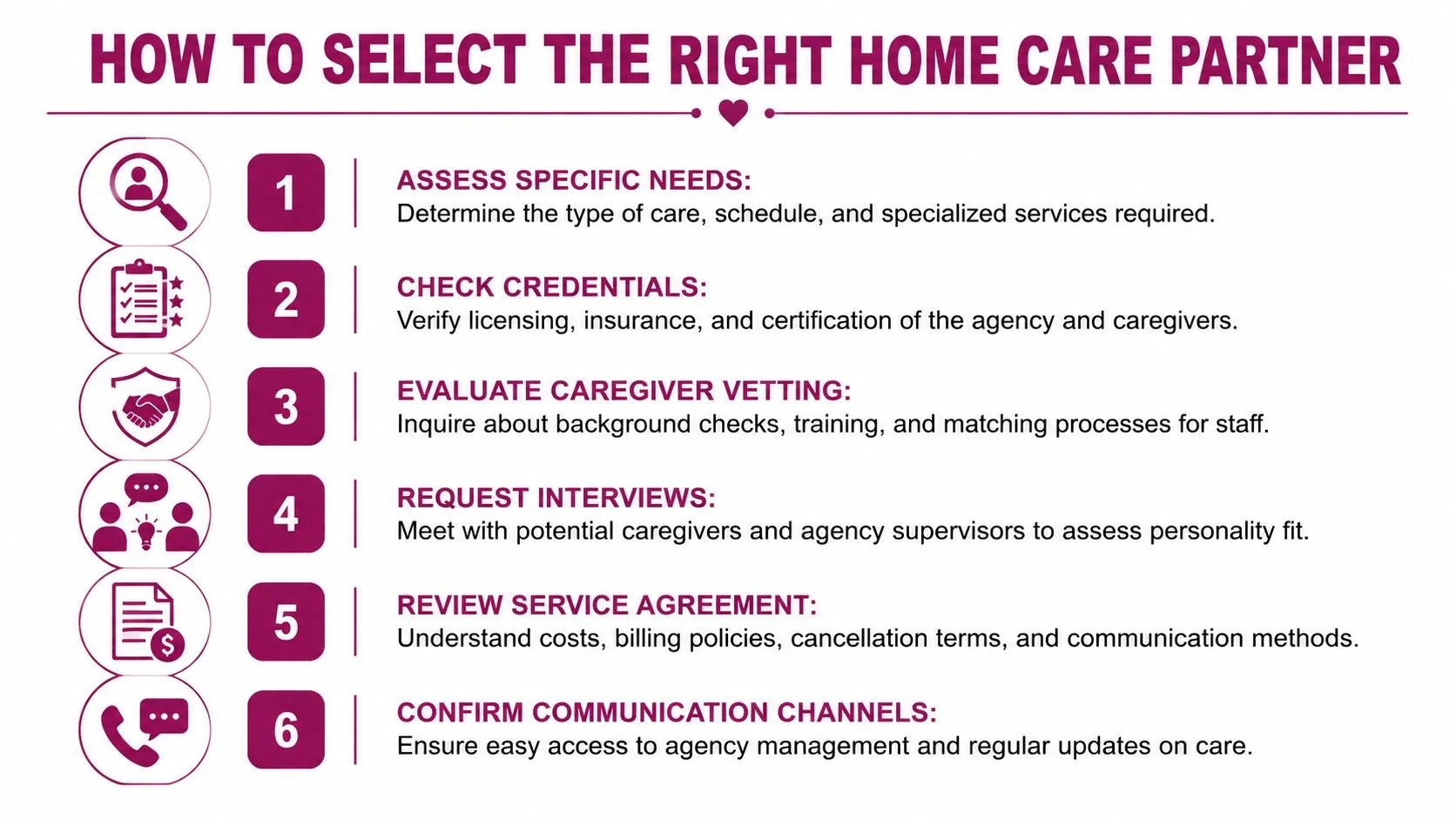
How to Select the Right Home Care Partner
Choosing a provider isn't just about availability. It's about whether the agency can deliver care that is safe, consistent, and matched to the person in the home. A polished conversation matters less than the agency's actual process.
Questions that reveal how an agency operates
The most useful questions are the ones that expose what happens after intake. Families should ask direct questions and listen for specific answers.
Caregiver vetting: How are background checks handled, and what screening happens before a caregiver enters a home?
Training standards: What training do caregivers receive for personal care, mobility support, and neuro-related needs?
Matching process: How does the agency decide which caregiver is a good fit for a client's personality, routine, and care needs?
Supervision and communication: Who checks in on the plan, and how are families updated when concerns come up?
Coverage reliability: What happens if the regular caregiver is sick, unavailable, or not the right fit?
Care plan revision: How quickly can services adjust when a client declines, improves, or returns home after hospitalization?
A dependable agency can explain its process without vague language. Families should hear who does what, when they do it, and how communication works.
What a strong care plan should include
A meaningful plan starts with an in-home assessment. That visit should look at more than a diagnosis or a list of tasks. It should consider home layout, fall points, bathroom setup, mobility habits, sleep patterns, nutrition concerns, transportation needs, cognitive changes, family involvement, and what the client wants to preserve.
One factual example of this model is A Better Solution in Home Care, which begins services with a complimentary in-home assessment and personalized plan of care, and offers non-medical caregiving, wellness support, telehealth access, and neuro-focused assistance in Boise and Reno.
A free consultation is valuable here because it lets a family compare process, not just promises.
Your Next Steps for Care in Boise and Reno
Families in Boise and Reno usually don't need more general information. They need clarity about their own situation. Is a parent lonely and forgetting meals, or already unsafe in the shower? Is transportation the main issue, or is mobility declining fast enough that personal care should start now? Is a neuro condition creating unpredictable days that require closer support?
Those questions are easier to answer in the home than over the phone. A no-obligation assessment allows a care team to see the environment, hear the family's concerns, and build a plan around actual routines instead of assumptions.
For local families exploring senior care at home, the next practical step is to schedule a free consultation with a provider serving the area. Those looking in Idaho can start with the Boise home care location page to learn about local availability and support options.
The best first move is usually simple. Identify the hardest parts of the week, write down safety concerns, and ask for an in-home conversation. Good care planning doesn't begin with pressure. It begins with an honest look at what would make home life safer, calmer, and more sustainable for everyone involved.
Sources
Source TextU.S. home care industry statisticsSenior home health trends on remote monitoring and aging in place
If a loved one could benefit from senior care at home, companion support, personal care, neuro-focused assistance, or proactive wellness services, schedule a free consultation with A Better Solution in Home Care. A no-obligation conversation can help clarify the right level of support, review payment options, and create a personalized care plan for life at home in Boise or Reno.